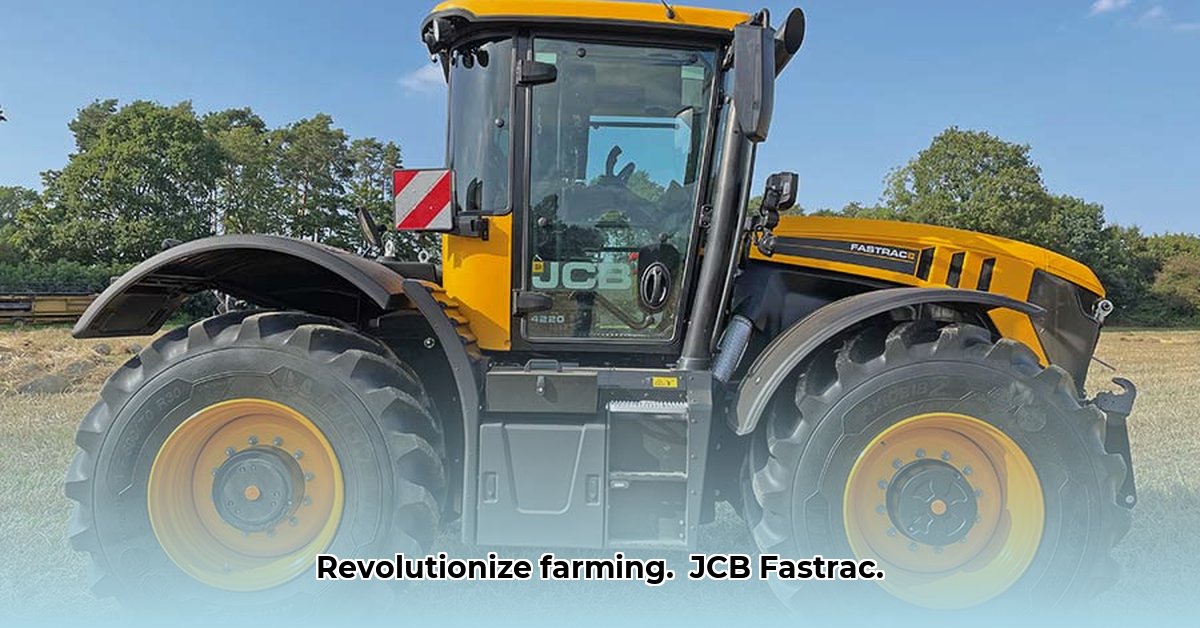
The JCB Fastrac tractor represents a significant departure from traditional agricultural machinery, prioritizing speed and efficiency alongside sustainability considerations. This article analyzes its suitability for modern farming practices, considering performance, costs, and environmental impact. We will explore whether the JCB Fastrac's unique capabilities justify its higher price point and contribute to a more sustainable agricultural future. For comparison, see other tractor options like those from Mahindra Tractors.
Key Features and Specifications
The JCB Fastrac distinguishes itself with its high road speed (up to 43 mph), a feature that significantly reduces time spent traveling between fields. Its powerful engine, precise steering, and advanced suspension system contribute to efficient operation and operator comfort. Key sustainable attributes include potential reductions in soil compaction due to the suspension and the possibility of reduced fuel consumption per unit of work depending on operational conditions. However, specific fuel efficiency data and a comprehensive lifecycle analysis of the manufacturing process are needed for a complete sustainability assessment. The center-mounted cab provides enhanced visibility crucial for precision farming techniques.
Performance Analysis
The JCB Fastrac's high road speed translates into significant time savings, especially on large farms with distances between fields. However, field operation speeds, while respectable, may not always surpass those of comparable competitors, especially in demanding conditions. Independent testing data would be beneficial to compare its in-field efficiency with like tractors. The superior ride and stability, attributable to the full suspension, positively impact both operator comfort and potentially minimize soil compaction compared to conventional tractors. Further data on comparative soil compaction levels under various field conditions would strengthen this claim.
Cost Analysis
The JCB Fastrac commands a premium price. New models can exceed $393,251, while used models start around $39,900 (with approximately 3000 operating hours). Operational costs, including fuel, maintenance, and potential repairs, are also substantial. The high cost of parts is a critical factor to be considered in assessing long-term costs. Leasing options may mitigate the initial investment burden, but long-term leasing costs must be carefully assessed against potential purchase options. A thorough cost-benefit analysis – considering farm size, work intensity and operational efficiency – is essential for determining financial viability.
Sustainability Assessment
The JCB Fastrac's potential contribution to sustainable agriculture hinges on several factors. The full suspension system minimizes soil compaction, promoting healthier soil structure, better water infiltration, and potentially higher crop yields. However, a detailed assessment of its manufacturing process, including material sourcing and lifecycle emissions, is needed to fully evaluate its environmental footprint. The claim of reduced fuel consumption needs further validation through independent, comparative testing under diverse operating conditions.
Market Position and Competitor Analysis
The JCB Fastrac occupies a niche market segment, competing with other high-specification tractors boasting speed and advanced features. However, a detailed comparison with key competitors, factoring in price, fuel efficiency, maintenance costs, and overall sustainability metrics (including lifecycle environmental impact) remains crucial to accurately assess its competitive advantage. The availability of long-term operational data from farmers utilizing various models would contribute to a more comprehensive comparison.
Conclusion
The JCB Fastrac tractor offers a compelling blend of speed, comfort, and potential for reduced soil compaction. Its high purchase and operating costs, however, require careful consideration. The lack of readily available detailed data on long-term fuel consumption, lifecycle environmental impacts, and comparative field work efficiency necessitate further investigation. Farmers considering a JCB Fastrac should conduct a comprehensive cost-benefit analysis, weighting the efficiency gains against the higher initial and operational expenses. The final verdict hinges on a farm's specific needs, operational scale, and commitment to sustainable practices. While the potential for boosting efficiency and minimizing soil compaction is exciting, comprehensive data is needed before universally recommending this tractor for sustainable agriculture.